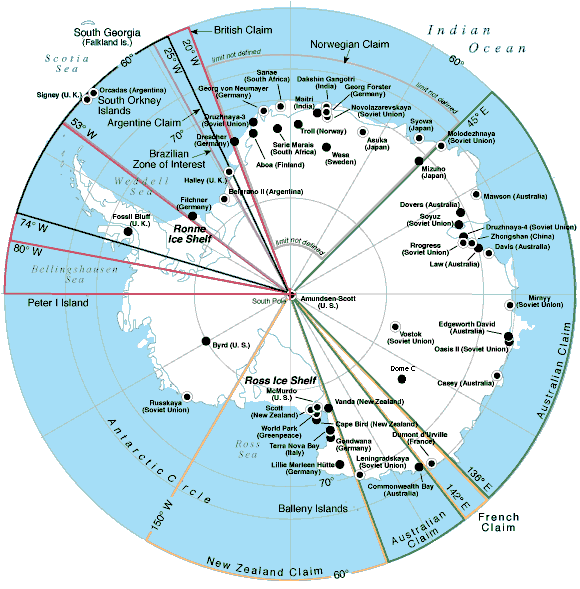
Geography
People
Government
Economy
Transportation
Communications
Defense Forces
Location: continent mostly south of the Antarctic Circle.
Map references: Antarctic Region.
Area: total area: 14 million sq km, land area: 14 million sq km, comparative area: slightly less than 1.5 times the size of the US, second-smallest continent (after Australia).
Coastline: 17,968 km
Climate: severe low temperatures vary with latitude, elevation, and distance from the ocean; East Antarctica is colder than West Antarctica because of its higher elevation; Antarctic Peninsula has the most moderate climate; higher temperatures occur in January along the coast and average slightly below freezing.
Terrain: about 98% thick continental ice sheet and 2% barren rock, with average elevations between 2 000 and 4 000 meters; mountain ranges up to 4 897 meters high, glaciers form ice shelves along about half of the coastline, and floating ice shelves constitute 11% of the area of the continent.
Natural resources: iron ore, chromium, copper, gold, nickel, platinum and other minerals.
Land use: desert land: 0%, permanent crops: 0%, meadows and pastures: 0%, forest and woodland: 0%, 100% (ice 98%, barren rock 2%); Irrigated land: 0 sq km.
Environment:
Current issues: in October 1999 it was reported that the ozone shield, which
protects the Earth's surface from harmful ultraviolet radiation, had dwindled to
the lowest level recorded over Antarctica since 1975 when measurements were
first taken.
Natural hazards: Winds blow coastward, frequent blizzards form near the bottom
of the plateau; cyclones form over the ocean and move clockwise along the coast,
volcanism happens in the areas of West Antarctica. The coldest, windiest,
highest, and driest continent.
Population: no indigenous
inhabitants; note: there are seasonally staffed research stations.
Summer (January) population: over 4,115 total
Year-round stations: 42 total
Summer only stations: over 38 total
Names: conventional long form: none; conventional short form: Antarctica.
Overview: No economic activity at present except for fishing off the coast and small-scale tourism, both based abroad.
Ports: none; offshore anchorage.
Airports: 42 landing facilities at different locations operated by 15 national governments party.
Telephone system: NA
Radio: broadcast stations: AM NA, FM NA, shortwave NA.
Television: NA
Antarctic Treaty prohibits any measures of a military nature, such as the establishment of military bases. The carrying out of military activities.